Introduction
You just closed the deal. The email came through, the contract is signed, and for one bright moment everything feels possible—you shook hands (maybe virtually), the client is excited, and you finally let out the breath you'd been holding through weeks of pitching. This is the win you worked for.
Then the silence sets in. The days after a "yes" have a strange, foggy quality: a few back-and-forth emails, a vague "we'll get started soon," the client unsure of what happens next, and both of you quietly waiting for the other to make the first move. Nothing is technically wrong, yet nothing is moving either.
That empty stretch costs more than it looks. The confident first impression you worked so hard to earn starts to fade, and somewhere in the quiet your new client begins to wonder—privately—whether they made the right call.
Here's the thing worth noticing: there is a real gap between closing the deal and actually beginning the work, and how you handle that gap sets the tone for the entire relationship. It's the opening move, and clients feel it long before they can name it.
If any of this sounds familiar, you're not doing anything wrong. This messy in-between is incredibly common, and it doesn't mean you're unprofessional or disorganized. It usually just means one piece is missing—a bridge between "signed" and "started."
In this article, we'll answer two simple questions in plain language: what client onboarding actually is, and how a small service business can do it well without a big team or expensive software.
And the best place to begin is with the part most people skip past—getting clear on what this thing really is in the first place.
So let's stop circling the question and answer it head-on.
Client onboarding is the entire bridge between the moment a client says "okay, let's do this" and the moment you actually deliver something or begin the work you were hired for. It's everything that happens in that gap. The whole point of that bridge is to take someone who, minutes ago, was a stranger who just handed over money, and turn them into a confident partner who knows exactly what happens next, what's expected of them, and why they made the right call. In other words, it's the difference between a client who feels looked after from day one and one who quietly starts wondering whether they just wasted their budget.
Two quick distinctions make the definition sharper and stop it blurring into the things sitting on either side of it. First, onboarding is not sales. Selling is the part where you convince someone to say yes and pull out their wallet — and by the time onboarding starts, that's already done. You're not persuading anyone to buy; they've bought. Second, onboarding is not the delivery itself. Delivery is the hands-on stage where you actually build the thing, run the campaign, write the code, or provide the service — the part that produces the results they paid for.
Onboarding lives in the space between those two. It's the connective tissue. Its job is to build trust while it's still fragile, set clear expectations before anyone can form the wrong ones, and gather the information, assets, and access you need to start the real work without friction. Done well, none of it feels like admin; it feels like the relationship finally clicking into gear. Skip it, and you drop a paying client straight from "yes" into "why hasn't anything happened yet?"
So if you want one sentence you can repeat to a colleague tomorrow: client onboarding is the structured handoff that turns a new buyer into a ready, confident client — bridging the gap between the sale and the work. Keep that definition in your back pocket, because in the next section we'll drop it into a real scenario and watch it turn from an abstract idea into something you can actually picture.
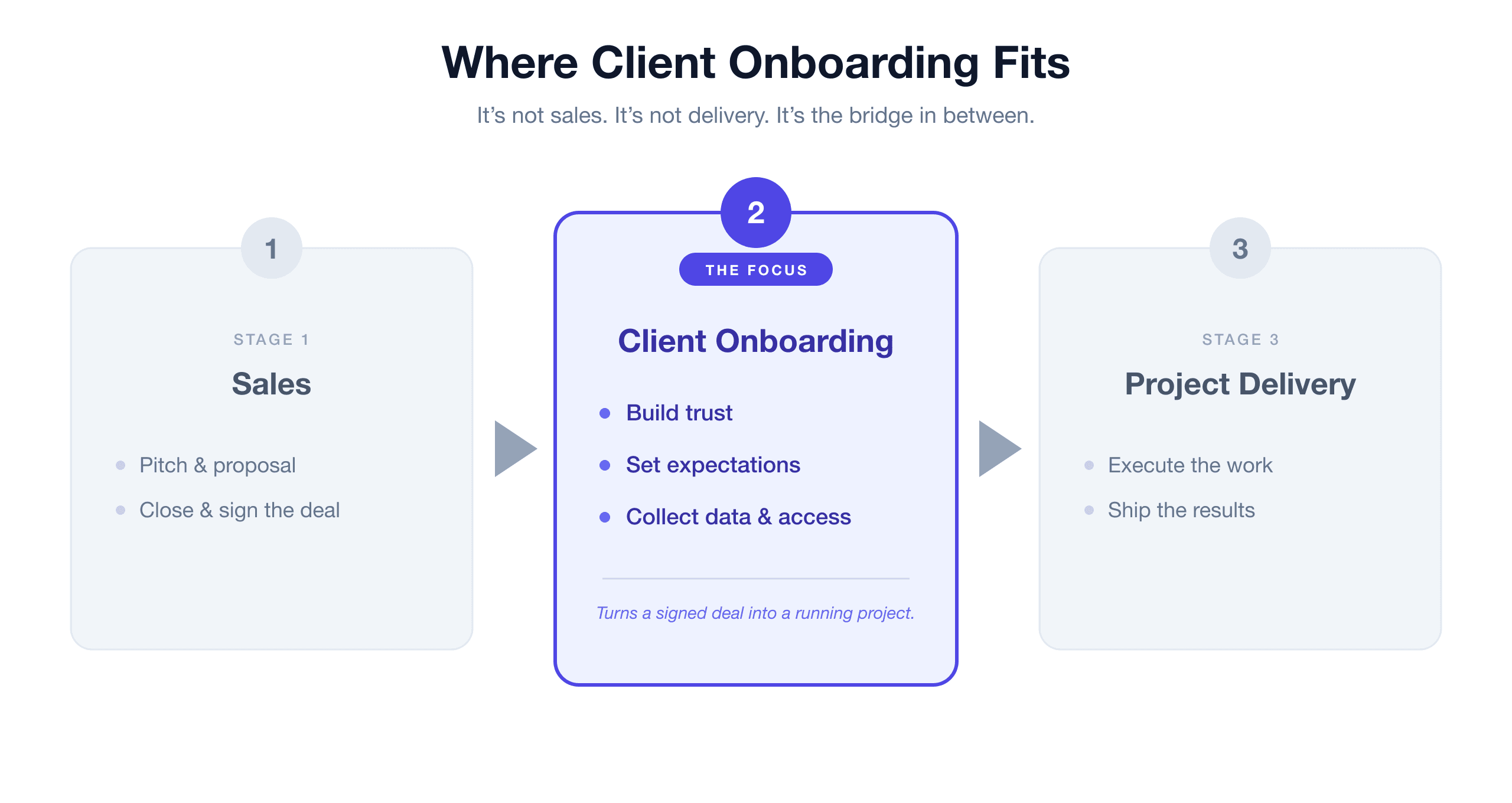
Client onboarding sits between sales and delivery — the bridge that turns a signed deal into a running project.
What Onboarding Looks Like in Real Life: An Example
It's easy to nod along to a definition and still not quite see it. So let's trade the abstract for something you can picture.
Meet Maya, a freelance web designer who has just landed a new client. The contract is signed, the deposit has cleared, and everyone is excited. Then—nothing. In the first version of this story, Maya goes quiet. She's heads-down mapping out the project in her own notebook, assuming the client knows she's on it. But the client doesn't know. They received no message, no next step, no sense of what happens now. They're left staring at their inbox, guessing.
You can imagine how that feels. Within a week, the client is anxious. They send a "just checking in" email. Then another. They wonder if they picked the wrong person, or if the project has stalled before it began. Nothing has actually gone wrong with the work—but the silence has already started chipping away at their trust, one unanswered day at a time.
Now rewind, and watch the same designer do it differently.
The moment the contract is signed, Maya sends a warm welcome email: thrilled to work with you, here's what to expect this week. A day later, she follows up with a short, friendly checklist—brand assets, logins, copy, examples of sites they love—so the client knows exactly what to hand over and when. She puts the scope and timeline in writing, in plain language, so there's no fuzzy space to worry inside of. Then she books a kickoff call, thirty minutes to align on goals and answer questions face to face. And before the week is out, she delivers one small thing: a homepage moodboard, a rough layout, a first tangible sign that momentum is real.
Put the two versions side by side and the difference isn't the talent—it's the experience. In the first, the client is nervous and in the dark. In the second, the same client feels held. They know what's happening, they know what's expected of them, and they can see the work moving. That confidence colors everything that follows.
Here's the part worth sitting with: the onboarding didn't change whether Maya was good at her job. It changed whether the client ever got to feel it. If you've ever been that anxious client—or worried you might be Maya in version one—you already know how much those first few days decide.
Which raises the real question: when does getting onboarding right matter most?
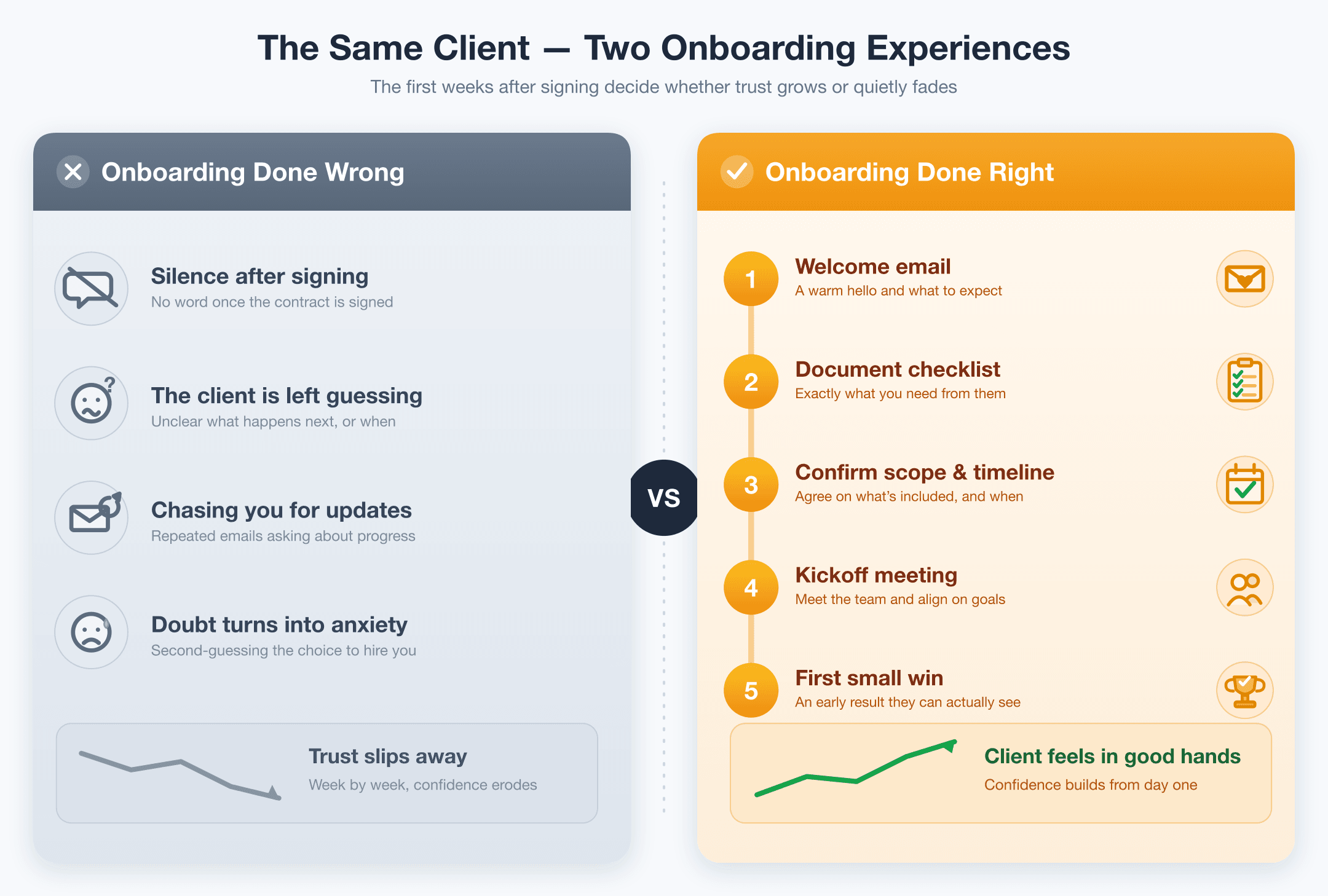
The same client, two onboarding experiences: silence and eroding trust versus a paced flow from welcome email to first small win.
When Does Client Onboarding Matter Most?
Onboarding isn't a luxury reserved for large companies with dedicated operations teams. In fact, for small service businesses, a deliberate onboarding process can matter more, not less—because when you're running lean, every client relationship carries real weight, and there's little margin for a rocky start.
The relevance here is remarkably broad. Whether you're a consultant scoping a strategy engagement, a designer kicking off a brand project, a bookkeeper taking on a new account, an agency signing a retainer, or a coach welcoming a client into a program, the same principle applies. Any one-to-one or project-based service benefits from an intentional handoff between "yes, let's work together" and the actual work.
Consider what a strong onboarding actually solves. The first problem is early client churn. The opening weeks are when a new client feels most uncertain—unsure they made the right choice, unsure what happens next. A clear, reassuring start keeps them from second-guessing and quietly walking away before you've had the chance to deliver value.
The second problem is scope and money. When you spell out exactly what's included, what isn't, and on what terms, up front, you prevent scope creep from eroding your margins and head off the awkward payment disputes that surface when expectations were never made explicit.
The third benefit is reputation. A polished, thoughtful first impression does more than reduce risk—it actively turns a new client into a happy one, the kind who feels well cared for and refers you to others without being asked. For a small business, that word-of-mouth engine is often the single most valuable source of growth.
The fourth benefit is your own sanity. Without a system, every new client means answering the same questions from scratch, resending the same forms, and re-explaining the same steps. A repeatable onboarding process fixes all of that in place once, so you're not reinventing the welcome each time.
Put together, these aren't minor conveniences—they touch retention, revenue, referrals, and your workload directly. So if onboarding matters this much, the natural next question is a practical one: how do you actually build it, step by step? That's exactly what we'll walk through next.
How to Onboard a New Client, Step by Step
Now that you understand what's at stake, let's get practical: the rest of this guide walks through a process you can copy and reuse for every new client, and we'll start with the first three steps.
Step 1: Send a welcome message the moment the deal is signed. As soon as a client says yes, fire off a short welcome email—or even a quick message—to confirm that the partnership is officially underway. This small step carries far more weight than it looks. Right after signing, a client's excitement and expectations sit at their peak, and a warm, prompt note locks in a strong first impression before any second-guessing has a chance to creep in. Better still, you don't need to write it from scratch every time; a simple reusable template gets the job done in seconds.
Step 2: Collect everything you need with a single form. Rather than emailing back and forth for logins, brand assets, and account details, send one form or questionnaire that gathers all the information and access you'll need up front. The payoff is fewer interruptions later on. Chasing a client for one missing password today and a stray link next week is slow and draining for both sides—asking once, clearly, keeps the project moving instead of stalling. And you don't need anything fancy to pull this off: a free form tool is more than enough to set it up.
Step 3: Put expectations in writing. Before any real work begins, spell out the details in black and white—the scope of what you'll deliver, the timeline, how the two of you will communicate, and the payment terms. Setting this down clearly is your single best defense against misunderstandings and disputes down the road. When everyone agrees on what "done" looks like from day one, there's far less room for awkward surprises about missed deadlines or unexpected invoices, and the relationship starts on a foundation of trust rather than assumption. This doesn't have to be a formal, lawyer-drafted contract, either—a single-page document or a well-written email will usually do the trick.
With the first three steps behind you—the welcome email, the paperwork, and the account setup—the back half of onboarding is where a client actually starts to feel like a client. Here's how the last three steps play out.
Step 4: Book a kickoff call to align on goals and who does what.
This is the step people are tempted to skip, and it's the one that saves you the most grief later. A live conversation—in person or over video—clears up the small assumptions that quietly turn into big problems: what "done" looks like, who owns which task, when things are due. You don't need an hour. A focused 30-minute call is usually enough to get everyone pointed in the same direction.
Step 5: Deliver an early quick win.
Find something small you can finish in the first week or two and get it in front of the client fast. Early results build confidence in a way that promises never do. When a client sees momentum right away, it quietly confirms they made the right call in hiring you—and that goodwill carries you through the slower stretches that come later.
Step 6: Set a regular rhythm for updates and reporting.
Decide upfront how often you'll check in—weekly, biweekly, monthly—and then stick to it. A predictable cadence means the client never has to wonder how things are going or chase you for a status. And it doesn't have to be heavy: a recurring calendar hold and a simple report template are all it takes to keep the updates flowing without extra thinking on your part.
That's the full six steps, from first hello to steady rhythm. Run through them once and they feel simple enough. Run through them for every new client, by hand, and the cracks start to show—one step gets skipped when you're slammed, the kickoff call slips, one client gets a polished experience while the next gets a rushed one. The process itself works; doing it manually every single time is what breaks down. In the next section, we'll look at how to turn these six steps into a repeatable system—so every client gets the same smooth start, without you having to remember a single thing.
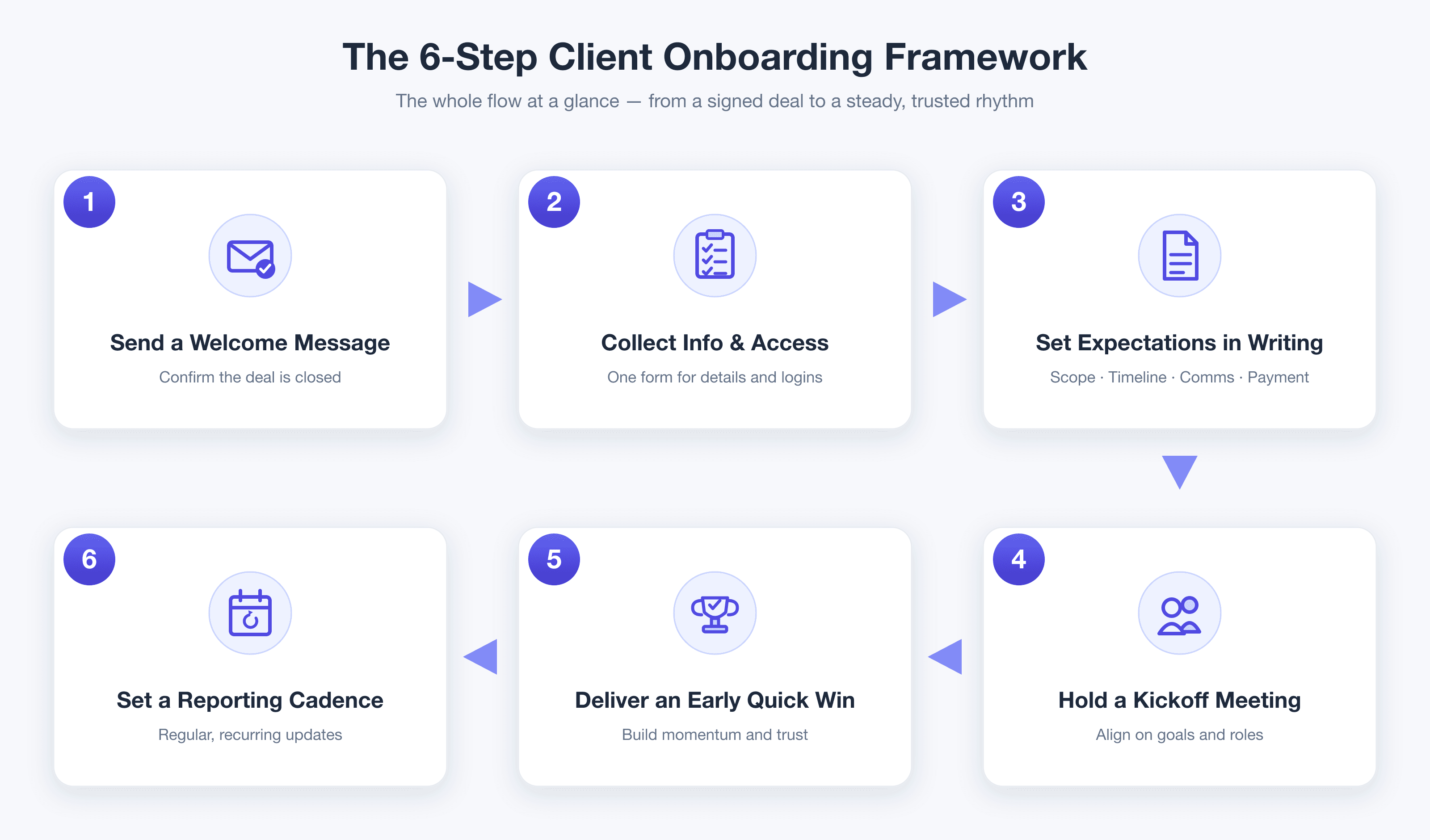
The six-step client onboarding framework at a glance — from confirming the signed deal through to a regular reporting cadence.
That flowchart you just walked through? You can take it with you. We've turned all six steps into a checkable Customer Onboarding Checklist, and paired it with a ready-to-send welcome email template—free to download, no sign-up required, so it's ready for the moment your next new client comes through the door.
Turn Onboarding Into a System, Not a Sprint
By now the pattern is hard to miss. Running onboarding by hand — one client, one checklist, one manual nudge at a time — costs you the same three things over and over: the hours you burn repeating the same setup, the steps that quietly slip when you're slammed, and the uneven first impression that leaves one client delighted and the next one lost.
Here's the shift worth making. Great onboarding doesn't depend on you remembering every detail or summoning fresh energy for each new signup. It can be built once and left to run. The willpower you've been spending is really a design problem, and design problems have systematic answers.
Systematizing it is simpler than it sounds: take the six steps you just walked through and lock them into a template you reuse, instead of rebuilding the flow from scratch for every customer. The sequence stops living in your head and starts living in the process.
Picture how the front half connects. The moment someone signs up, a welcome message goes out on its own. The intake form that collects what you need to get started fires right behind it. The document that sets expectations — timelines, next steps, who owns what — lands without you lifting a finger. Three touchpoints, one continuous handoff.
The back half is what keeps it honest. Task reminders make sure nothing stalls between steps, and a visible progress view shows exactly where each client stands. Nothing falls through the cracks, and every new customer moves down the same clean path — so the tenth person gets the same polished welcome as the first.
Mapped to features, the abstraction gets concrete fast. Automated welcome emails cover the greeting. Smart intake forms handle collection. Shared expectation docs set the tone. Reminder workflows carry the follow-through, and a status dashboard makes the whole journey legible to you and your client at a glance. Each step you used to do by hand now has a tool doing it for you.
That's the real takeaway: onboarding isn't a talent you have to keep proving — it's a process you can put in place once and trust to hold. If the manual version has been draining your week, this is where you fix it. Build the template, wire up the automations, and let the system carry the weight your willpower has been shouldering all along.
Ready to stop running every onboarding on willpower alone? Create your free account and apply the template you just saw to every new client with a single click—welcome emails go out on their own, the details you need collect themselves, and progress tracks quietly in the background, so no one slips through and everyone gets the same steady start. Turn the silence that follows a signed deal into the reassuring opening your clients were hoping for, starting today.
Conclusion & Next Step
Client onboarding isn't an afterthought—it's the moment you turn the messy silence that follows a sale into your very first act of trust. Everything we've covered comes back to this single shift: the gap right after someone says "yes" isn't dead space to survive, but the opening scene of the relationship you're about to build.
For a small service business, that shift pays off in ways you feel directly. A steady onboarding flow lifts client retention, turns satisfied customers into the word-of-mouth referrals that quietly fill your calendar, and spares you the repetitive back-and-forth that eats your week—the same questions, the same forms, the same chasing, over and over.
Here's the part that matters most: you don't have to get it perfect on day one. The barrier to starting is far lower than it looks. You don't need a polished, fully automated system before you begin—you just need a minimum viable version that works today.
So what does that smallest step look like? A single, warm welcome email that tells the client exactly what happens next, paired with one simple intake form that gathers the details you'd otherwise dig for later. That's it. Two pieces, and the silence is already broken.
Remember the picture we opened with—the new client staring at an empty inbox, wondering if they made the right choice. That "silence after the sale" is precisely what you're replacing, and in its place you hand them a calm, confident opening they'll remember.
So take the next step. Start with that welcome email and intake form this week, then let the solution carry the rest—systematizing your entire onboarding once, so every future client meets the same reassuring first impression without you rebuilding it each time.
Frequently Asked Questions
How long should client onboarding take? There's no fixed number—it scales with the size of the engagement—but the aim is to move fast. Send the welcome message within hours of signing, and wrap up the core handoff (intake form, written expectations, kickoff call) inside the first week. What matters isn't hitting a specific length; it's that the client is never left sitting in silence wondering what happens next.
What if a client is slow to respond or won't complete the intake form? This is exactly why Step 2 uses one clear form instead of scattered emails—it lowers the effort on their end. If they still stall, a short, friendly nudge that ties the missing item to their own timeline ("as soon as we have your logins, we can start building") usually does the trick. Naming a soft deadline in your welcome message up front prevents most of this before it happens.
Can I use this process for clients I already have? Yes. Although onboarding is built for the moment someone signs, the same six steps work as a reset for existing relationships—especially ones that started messily. Sending a clear expectations document and locking in a regular reporting rhythm can steady a project that never got a proper opening, without you having to start the whole engagement over.