"So we're still good at twelve hundred, right?" The client says it lightly, the way you'd confirm a lunch order, already reading your March quote back to you like it's this morning's weather. For a second you almost nod. Then it lands: that number died in a rate revision months ago. Twelve hundred isn't your price anymore — it's a fossil, and you're the only one in the room who knows it's extinct. Now watch what just happened to the floor beneath you. You haven't opened your mouth, haven't named a figure, haven't set a single term — and you're already on the back foot, explaining, hedging, deciding whether to eat the gap or look like you're hiking prices mid-conversation. The reply is supposed to be yours to make. Instead you're defending a version of yourself you left behind in spring.
Here's the mechanism nobody warns you about: the instant a price leaves your hands as a file, it stops being yours. It becomes their copy. Their artifact. A thing that lives on their drive, in their inbox, in their forwarded thread — and it freezes at the exact moment you hit send. It doesn't know you've since raised your rate, tightened your scope, or walked away from that offer entirely. It just sits there, perfectly preserved, saying twelve hundred forever. And to the person holding it, that frozen number doesn't read as expired. It reads as true — the price, the real one, the one you gave them. What you charge today is your private business; what they have is the receipt.
Now multiply that one email. Every quote, every deck, every PDF you've ever attached is still out there somewhere, quietly insisting on a number you may have abandoned long ago.
That one bad moment wasn't a fluke — it's how every file you send behaves. The awkward call about the wrong price wasn't caused by a careless mistake or a bad day. It was the system working exactly as designed. Once you understand that, you stop seeing an isolated slip and start seeing a pattern that repeats every single time you hit send.
Here's what actually happens the moment you attach a file to an email: you create a fork. The version you send freezes the instant the recipient saves it to their downloads folder. Your master copy can change a hundred times after that, but their copy doesn't know and doesn't care. It stopped listening the second it landed.
And those frozen forks don't sit still. One gets forwarded to the finance team for approval. Another gets dropped into a shared drive where it quietly becomes "the pricing sheet." Months later, a new hire opens it, sees no reason to doubt it, and quotes it to a customer as if it were pulled fresh this morning.
You have no way to count them. At any given moment, there could be five stale versions circulating, or fifty — you genuinely cannot know, because every one of them left your hands the day you sent it and kept traveling without you.
It gets worse. When a client calls and reads a number back to you, you can't tell which version they're looking at. Is it last quarter's rate? The one before the increase? The draft you sent by accident and corrected an hour later? You're negotiating blind against a copy you can't see.
This is the shift worth sitting with. That first uncomfortable phone call felt like a one-off — an embarrassing coincidence you'd laugh about later. It isn't. It's the moment you realize the truth underneath all of it: you don't actually control your own prices. Your files do.
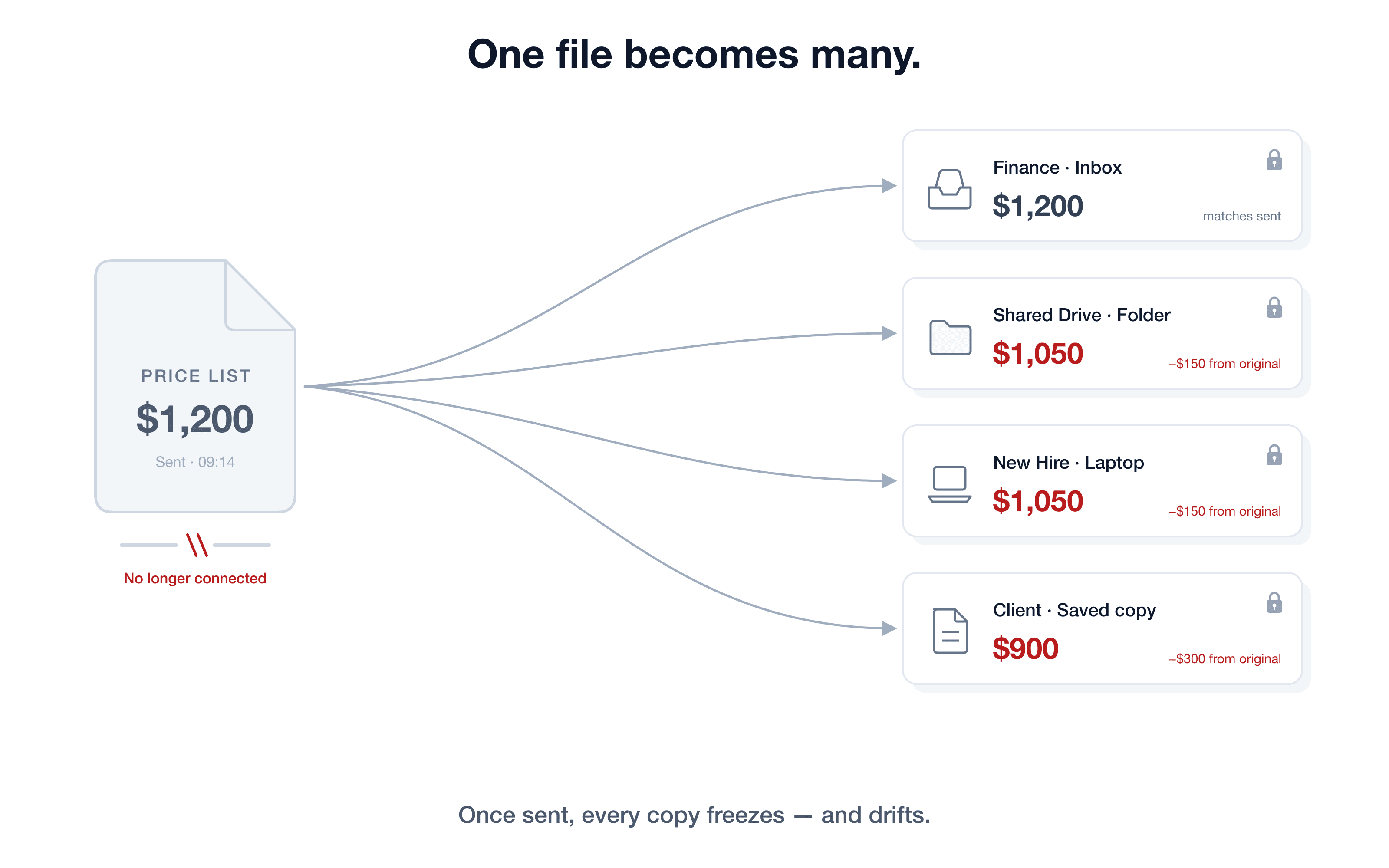
Once sent, every copy freezes — and drifts.
The Real Price of an Outdated Number
Losing control of your price list isn't just an operational annoyance — it's a bill that comes due, over and over, in ways you can measure. So let's stop talking about the loss of control itself and start adding up what it actually costs you.
The first cost lands on your margin. Every time a customer waves an old rate sheet at you and you feel you have no choice but to honor it, you're selling at a number you already walked away from — quietly funding their discount out of your own pocket. And you can't simply refuse, either. The moment you say "that price isn't valid anymore," you've told a customer their paperwork can't be trusted, and something in the relationship cools. Both doors cost you something on the way through.
Picture how it usually plays out. A client scoped a project back in the spring, and somewhere in that planning a member of their team pulled up your rate sheet from March and built the whole budget around it. By the time the job reaches you, the conflict is already baked in — the numbers were locked before anyone on your side said a word about price. Then the specifics surface. Their approved budget says $900. Your current sheet says $1,050. Two numbers are sitting on the table, both in writing, both "official," and you're the one who has to reconcile the $150 gap in real time, while the customer watches.
The cost doesn't stay outside your walls, either. Your own reps quote figures that contradict what the office is sending — the salesperson says one thing on the call, the invoice says another, and the client is holding both. When your documents openly disagree with each other, in writing, you leak something worth more than the $150. You leak authority. A customer doesn't need to understand your internal systems to read the signal: if your own paperwork can't agree on what something costs, then nobody over there is really steering the ship. The disagreement itself is the message.
And here's the part that stings across every one of these scenes. In the budget mismatch, in the $900-versus-$1,050 standoff, in the rep who quoted off memory — the story always resolves the same way. It isn't the stale spreadsheet that looks disorganized, and it isn't the customer who filed away an old number. It's you. Every single time, you're the one who ends up looking wrong.
You've probably blamed yourself for this. You told yourself you should have double-checked before hitting send, should have kept a cleaner system of folders, should have been more careful about which version went out the door. But the discipline was never the problem. The format was. No amount of personal diligence can fix a flaw that's baked into the medium you're working in — and once you see the mechanism clearly, the guilt stops making sense.
Here's the mechanism. A static file — a PDF, a spreadsheet, a printout, an exported image — is a snapshot. It captures how things looked at one specific moment and then freezes them there. The instant that file leaves your hands, it becomes physically incapable of changing. It cannot know that a price shifted, a date moved, or a number was corrected an hour later. It is a photograph of the truth, not the truth itself, and photographs do not update.
That distinction is where everything unravels. Because there's no single source of truth, every copy you send begins drifting from reality the moment you change anything on your end. You update the master. The version sitting in someone's inbox does not. Now two realities exist, and they quietly diverge — not because anyone did something wrong, but because that's simply what disconnected copies do.
And no, resending a "corrected" file does not rescue you. It feels like a fix, but watch what actually happens: you haven't replaced the old version, you've manufactured a new one to compete with it. The outdated copy is still sitting in the original thread, still downloaded to someone's desktop, still attached to an email nobody thought to delete. Every correction adds another contender to the pile. You're not closing the gap — you're multiplying it.
So let's name it plainly. Staleness isn't an accident of carelessness that better habits could prevent. It's a guaranteed output of the format itself. A static file is engineered, by its very nature, to fall out of date the moment reality moves on. Which means no amount of effort, vigilance, or discipline exercised inside that format can ever solve it. The only real fix is to stop working in a format that breaks this way.
The Fix: Distribute Access, Not Copies
The way out is smaller than it sounds, and it starts with a single change in habit: stop handing people copies of your prices, and start handing them access. The moment you send a file, you've made a duplicate that drifts the second you look away. Access doesn't drift, because there's nothing to duplicate.
The mechanism is refreshingly plain. Instead of attaching a spreadsheet or a PDF, you share one link that points to a living pricing page — a page that stays under your control, on your terms, updated whenever you decide it should be. Nobody downloads a version of it. They open the version, the only one that exists.
And here's what that buys you. Change a number once, in that single place, and everyone holding the link sees the new number the next time they look. There's no re-sending, no "please discard the earlier email," no quiet hope that the right file made it to the right inbox. One edit, and the update is already everywhere.
Replay the opening scene with this in place. It's September, a customer clicks the link you sent back in June, and the page simply shows September's price — because that's what the page says today. The stale quote from spring never surfaces, because it was never frozen into a copy in the first place. There's nothing old to resurface.
Replay the internal tug-of-war too. Your reps in the field and the team back at the office are no longer reading from whichever attachment they happened to save. They're all reading the same live source, so their numbers can't quietly disagree. When a customer asks the rep and then calls the office, the answer matches — not because everyone remembered to sync, but because there was only ever one answer to give.
Generalize it and the appeal gets clearer. A single edit propagates to every viewer at once. There are no scattered versions aging in downloads folders, no forgotten copies attached to old threads, nothing to hunt down and correct after the fact. You fix the source, and the fix is complete the instant you make it.
Set the two models side by side and the contrast is stark. The file-based way means many copies and zero control: once it leaves you, you can't touch it again. The link-based way means one source and full control — and that source is current by definition, because "the page" and "the latest page" are the same thing.
Which reframes the whole idea of staying up to date. "Always current" isn't a chore you keep performing, a discipline you have to sustain against entropy. With a single shared link, it's just the built-in state of things — the default you get for free, simply because there's only one place for the truth to live.
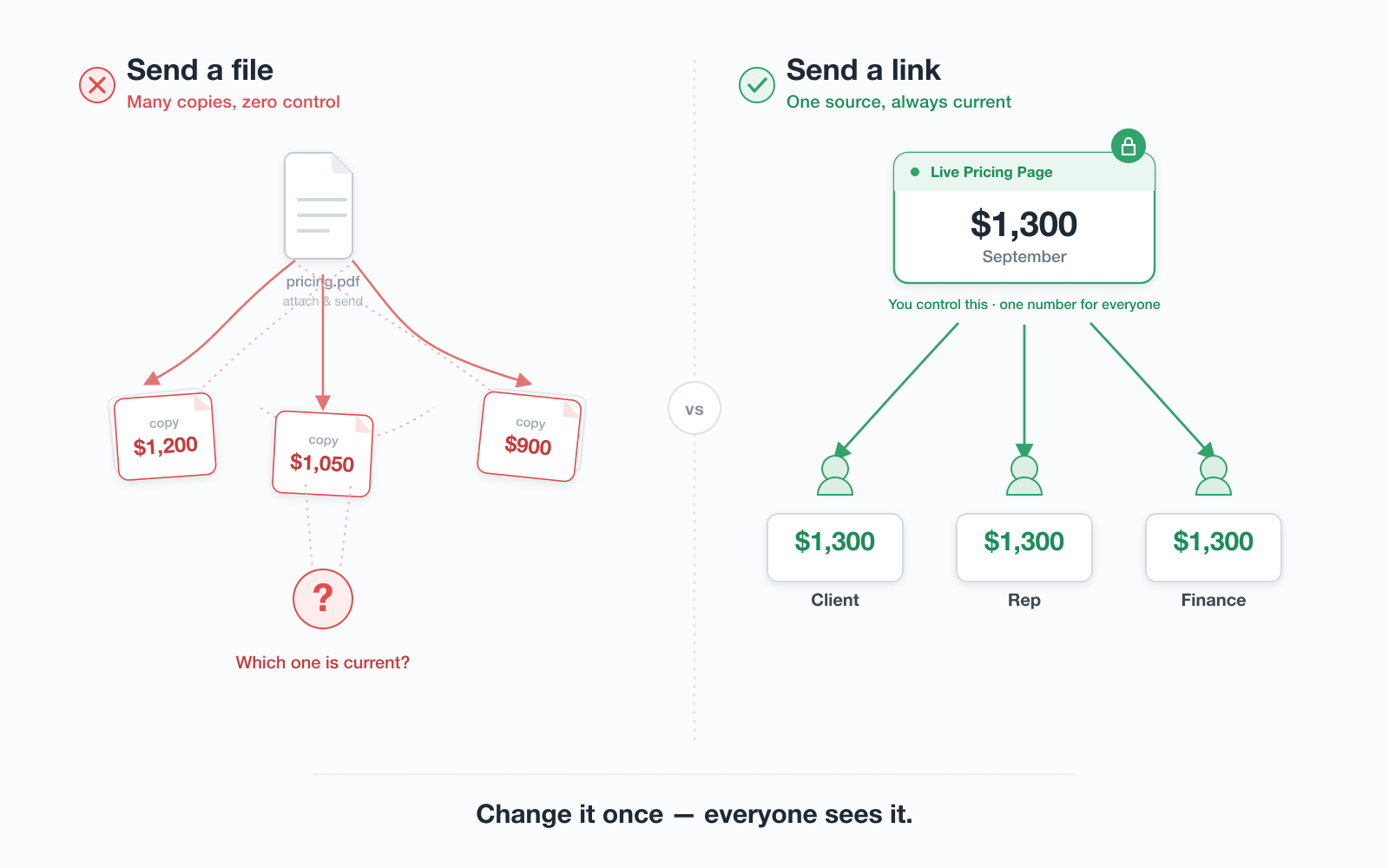
Change it once — everyone sees it: distributing copies creates conflicting prices with no control, while distributing a link keeps one source current for everyone.
That right-hand column isn't a mockup — it's how a live pricing link actually behaves. If you want to feel the difference rather than take my word for it, take thirty seconds and open one the way your client would: a single link, one current price, nothing to download and nothing to install. That's the whole interaction.
Remember that March quote — the one you emailed in spring, forgot about, and then had to walk back three months later when the client held it up like a receipt? With a single live link, that email simply can't happen anymore. There's no attached PDF to go stale in someone's inbox, no version to dig up and apologize for. The number your client sees is the number that's true today, because there's only ever one number to see.
That's the whole promise, stripped to its plainest form: you update the price once, and every client automatically sees the right figure. No re-sending. No "please disregard my previous email." No mental map of who got which sheet. You change it in one place, and the correction reaches everyone the instant they open the link.
So here's the small move that makes it real. Put your prices at a single live pricing link, and from now on, share that link instead of an attachment. That's it — one URL in your emails, your proposals, your signature, wherever a price used to travel as a file.
Do that, and the March price list stops being something you manage and starts being something you've simply left behind. You're no longer chasing down old copies or bracing for the quote that resurfaces at the worst moment. The version problem is gone, the apology emails are gone, and your attention is free to go where it actually belongs — on the next client, the next deal, the work in front of you.
Now do it with your own numbers. Put your prices on a single link you control, update them in one place, and let every client, sales rep, and finance inbox read the exact same current figure — while that March quote quietly becomes impossible to send. Create your live pricing page → and retire the stale attachment for good.
FAQ
Can't a client just screenshot the live page and freeze the price anyway?
They can capture what they see today — but a screenshot isn't the same weapon as a document you issued. When someone waves a screenshot at you, it's visibly their snapshot of a moment, not an official file that left your hands with your name on it, and the live link is right there to settle what the price actually is now. The whole stale-attachment problem comes from you handing over an authoritative-looking file that outlives its own accuracy. A link never does that, no matter how many times it's photographed.
What if a client genuinely needs a downloadable document for procurement or their records?
Then give them one on purpose — but make it a specific quote, not your standing price list. There's a difference worth keeping sharp: a living price list should always be a link, while a quote you've chosen to commit to can be a dated document with a clear validity window ("valid through October 15"). The problem this piece is about isn't honoring a number you deliberately locked — it's your everyday prices leaking out as files nobody set an expiry on and everyone treats as current forever.
If my prices live at a link, can competitors — or anyone who gets the URL — just look them up?
That's a decision you get to make, which is precisely the advantage. Because you own the page, you control who reaches it — it can be open, gated, or handed out as a separate link per client. A file you've already emailed gives you none of those choices; once it's out, it's out. If visibility is a concern, that's an argument for a link you can restrict, not against it — you simply can't restrict a PDF sitting in someone's downloads folder.
If I update the price, what happens to a deal that's already in motion?
Changing the source doesn't reach back and rewrite something you've already agreed to. A quote you've formally committed to is its own dated commitment; the live link governs new views and open-ended references, not a handshake you've already made. The practical habit is simple: the moment you and a client agree on a number for a specific job, lock it as a quote — and let the link keep everyone who hasn't committed reading today's real figure.